
Piskemark
Piskemark tilhører en gruppe ormeparasitter som forårsaker infeksjon hos mennesker gjennom kontakt med parasittegg og -larver. Slike infeksjoner er meget utbredte i utviklingsland.
Sist oppdatert:
22. mars 2019
Hva er innvollsmark?
Innvollsmarker - betegnes også innvollsormer - er en gruppe ormeparasitter som forårsaker infeksjon hos mennesker gjennom kontakt med parasittegg og parasittlarver. De overføres via jordsmonn og gjødsel. Dette er parasitter som trives i varm og fuktig jord i verdens tropiske og subtropiske land, og som er sjeldne i Norge. Når slike mark/ormer har kommet seg inn i et menneske, kan de leve i årevis i vår fordøyelseskanal.
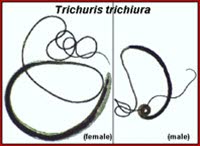 Piskemark
Tre typer innvollsormer dominerer. Det er spolorm (ascaris), piskemark (trichuris) og hakemark. Disse mark-/ormetypene forekommer ofte sammen, og særlig er mange barn kronisk infisert med alle tre innvollsmarkene.
Selv om disse infeksjonene er sjeldne i Norge og Skandinavia, så er de meget utbredte (endemiske) i utviklingsland. Ekspertene mener at mer enn 1 milliard mennesker er infisert med minst én markinfeksjon. Innvollsmark importeres ikke sjelden til Norge med adoptivbarn, innvandrere, u-landsarbeidere etc.
Dette dokumentet er basert på det profesjonelle dokumentet Piskemark, trikuriasis . Referanselisten for dette dokumentet vises nedenfor
- Smittervernveilederen. Marksykdommer - veileder for helsepersonell. Folkehelseinstituttet. Sist oppdatert 28.10.2018. fhi.no
- Bethony J, Brooker S, Albonico M, et al. Soil-transmitted helminth infections: ascariasis, trichuriasis, and hookworm. Lancet 2006; 367: 1521-32. PubMed
- Welch VA, Ghogomu E, Hossain A, et al. Mass deworming to improve developmental health and wellbeing of children in low-income and middle-income countries: a systematic review and network meta-analysis. The Lancet Global Health, 2017; 5 (1): PE 40-E50. DOI: 10.1016/S2214-109X(16)30242-X DOI
- Ojha SC, Jaide C, Jinawath N, et al. Geohelminths: public health significance. J Infect Dev Ctries 2014; 8:5. PubMed
- Bleakley H. Disease and development: evidence from hookworm eradication in American South. J European Econ Assoc 2003; 1: 376-86. PubMed
- Miguel EA and Kremer M. Worms: identifying impacts on education and health in the presence of treatment externalities. Econometrica 2003; 72: 159-217. PubMed
- Fincham JE, Markus MB and Adams VJ. Could control of soil-transmitted helminthic infection influence the HIV/AIDS pandemic? Acta Trop 2003; 86: 315-33. PubMed
- Le Hesran JY, Akiana J, Ndiaye HM, Dia M, Senghor P and Konate L. Severe malaria attack is associated with high prevalence of Ascaris lumbricoides infection among children in rural Senegal. Trans R Soc Trop Med Hyg 2004; 98: 397-99. PubMed
- de Silva NR, Brooker S, Hotez PJ, Montresor A, Engels D and Savioli L. Soil-transmitted helminth infections: updating the global picture. Trends Parasitol 2003; 19: 547-51. PubMed
- Brooker S, Clements A and Bundy DAP. Global epidemiology, ecology and control of soil-transmitted helminth infections. Adv Parasitol 2006; 62: 223-65. PubMed
- Weller PF. Anthelminthic therapies. UpToDate, last updated Mar 01, 2019. UpToDate
- Montresor A, Awasthi S and Crompton DW. Use of benzimidazoles in children younger than 24 months for the treatment of soil-transmitted helminthiasis. Acta Trop 2003; 86: 223-32. PubMed
- Savioli L, Stansfield S, Bundy DA et al. Schistosomiasis and soil-transmitted helminth infections: forging control efforts. Trans R Soc Trop Med Hyg 2002; 96: 577-9. PubMed
- Keiser J, Utzinger J. Efficacy of current drugs against soil-transmitted helminth infections. Systematic review and meta-analysis. JAMA 2008; 299: 1937-48. Journal of the American Medical Association
- Taylor-Robinson DC, Maayan N, Soares-Weiser K, et al. Deworming drugs for soil-transmitted intestinal worms in children: effects on nutritional indicators, haemoglobin and school performance. Cochrane Database Syst Rev 2012; 11:CD000371. Cochrane (DOI)
- Chan L, Bundy DA and Kan SP. Aggregation and predisposition to Ascaris lumbricoides and Trichuris trichiura at the familial level. Trans R Soc Trop Med Hyg 1994; 88: 46-8. PubMed